
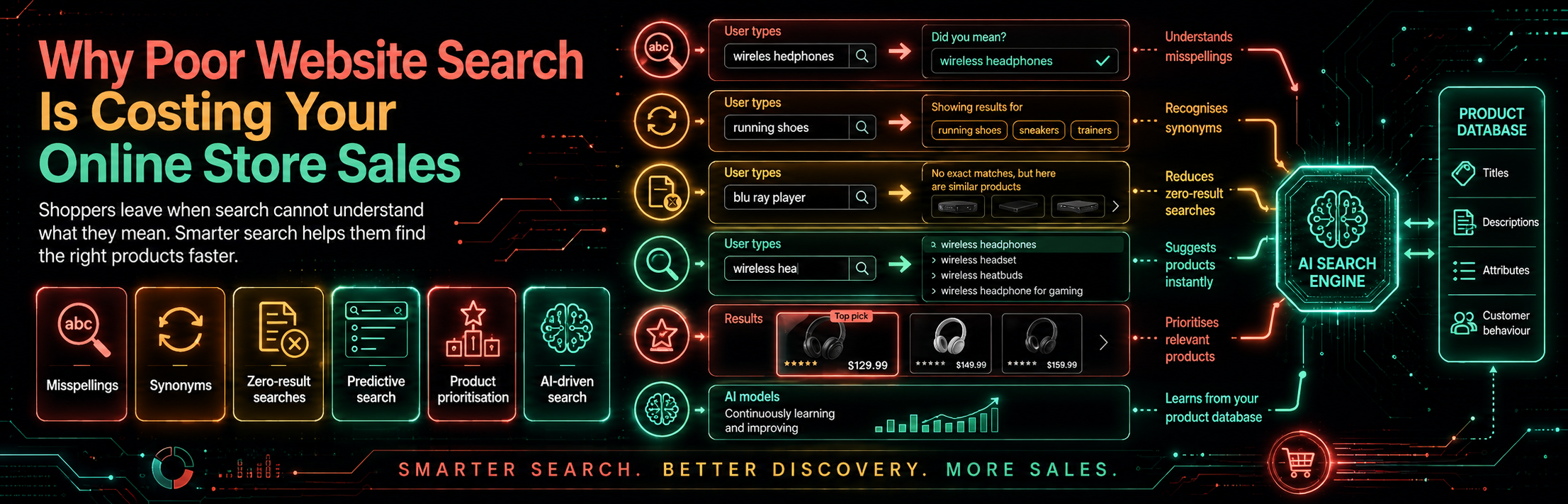
When customers use the search box on an ecommerce website, they normally know roughly what they are looking for. If the website cannot understand their search, the chances are they will simply leave and try somewhere else.
For stores with a large product range, good website search is just as important as navigation and product filters. A poor search function can hide products that are actually available and turn potential sales into lost customers.
Misspellings Shouldn't Mean No Results
Customers do not always spell product names, brands or technical terms correctly.
A customer searching for “bluetoot headphones” should still be shown Bluetooth headphones rather than a page saying there are no results.
A good ecommerce search should recognise common spelling mistakes and offer the closest relevant products.
Customers Use Different Words for the Same Product
Your product database may call something one thing while your customers call it something completely different.
For example, you may list a product as a “sofa”, while customers search for settee” or “couch”.
Search systems that understand synonyms can connect these different terms and make sure customers still find the right products.
Zero-Result Searches Are Lost Opportunities
One of the worst experiences for an online shopper is seeing:
“No products found.”
Sometimes the product they want is actually available, but the search system simply did not understand what they typed.
Instead of displaying an empty page, ecommerce search should be able to suggest similar products, alternative search terms, categories or related products.
Reviewing your website’s zero-result searches can also provide useful information about what your customers are trying to buy and where your product catalogue or search system could be improved.
Predictive Search Helps Customers Find Products Faster
Predictive or autocomplete search displays suggestions while the customer is typing.
This could include:
- Product names
- Product images
- Categories
- Brands
- Popular searches
Instead of making customers type a complete phrase and then browse through a results page, predictive search can take them directly to the product they are looking for.
This is particularly useful on mobile devices where typing longer searches can be more difficult.
Show the Most Relevant Products First
Finding products is only part of the job. They also need to appear in the right order.
If a customer searches for “black office chair”, they should not have to scroll through dozens of loosely related products before finding the obvious matches.
Product prioritisation can take into account things such as relevance, stock availability, popularity, sales history and promotional products.
The aim should always be to put the products most likely to satisfy the customer’s search near the top.
AI-Driven Search Can Take This Further
AI-driven ecommerce search is making website search considerably more intelligent.
Rather than relying only on exact keywords, an AI search system can learn from your product database, including product names, descriptions, categories, attributes and other product information.
This allows it to better understand what a customer is actually looking for.
For example, a customer might search for:
“waterproof jacket for walking the dog in winter”
Your website may not contain that exact phrase anywhere, but an AI-driven search system can understand the meaning behind the request and identify relevant waterproof, insulated or outdoor jackets from your catalogue.
AI search can also help deal with many of the traditional problems of ecommerce search, including:
- Misspellings and variations in wording
- Synonyms and alternative product names
- Longer conversational searches
- Searches where customers do not know the exact product name
- Poor or zero-result searches
- Ranking the most relevant products first
Because the search works with the information already contained within your product catalogue, the quality of your product data becomes increasingly important. Good descriptions, attributes, categories and specifications give the search system more information to work with.
Make Search Part of Your Sales Process
Website search should not simply be a box at the top of your website. It should actively help customers find the products they want and move them towards a purchase.
If customers are regularly receiving poor results, irrelevant products or no results at all, your website could be losing sales without you realising it.
Improving search with better spelling recognition, synonyms, predictive suggestions, product prioritisation and AI-driven search can make a significant difference, particularly for ecommerce websites with large or complex product catalogues.
The easier you make it for customers to find the right product, the easier you make it for them to buy.
Whats coming?
We are currently working on an AI search tool that can be added to your ecommerce website to improve these searh results and increase sales.
CALL US TO FIND OUT MORE: 01707 378455