
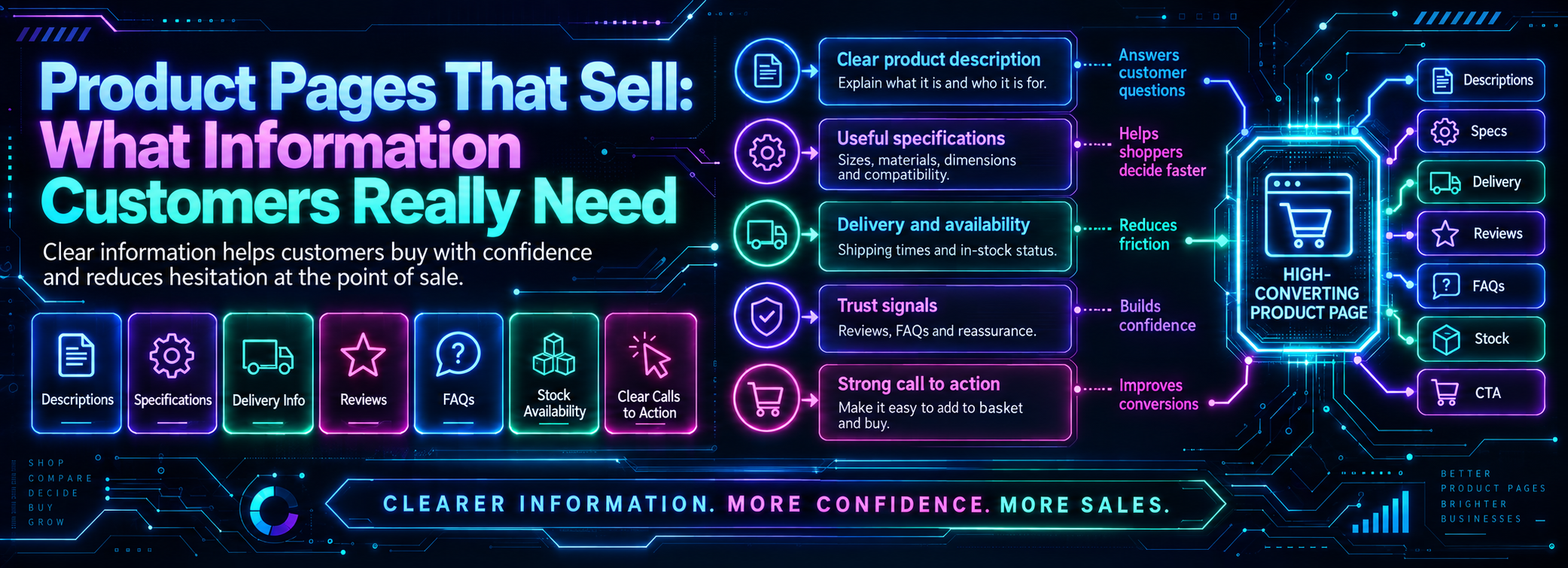
A good ecommerce product page needs to do more than simply display a product and a price. It needs to answer the questions a customer may have, build confidence in what they are buying and make it as easy as possible for them to place an order.
If customers cannot quickly find the information they need, they are far more likely to leave the website and look elsewhere.
Clear Product Descriptions
Product descriptions should explain what the product is, what it does and why someone would want to buy it.
Avoid relying entirely on short manufacturer descriptions. Wherever possible, provide useful information that helps the customer understand the product, its benefits and whether it is suitable for their requirements. (Don’ copy and paste descriptions from the manufacturer’s website, this is duplicated content and is not good, re-write it!)
Descriptions should be easy to read, with the most important information clearly visible rather than hidden within large blocks of text.
Well-written, unique product descriptions can also help search engines better understand the content of your pages, giving them more opportunity to appear for relevant product searches.
Detailed Specifications
For many products, specifications are just as important as the description.
Information such as dimensions, materials, colours, compatibility, capacity, model numbers, technical details and warranty information can all influence the buying decision.
Presenting specifications in a clear table or structured format also makes it much easier for customers to compare products.
Detailed specifications can also help your website appear for more specific searches where customers are looking for a particular size, model, feature or product type.
Delivery Information
Delivery is often one of the final questions a customer has before ordering.
Where possible, product pages should clearly show:
- Delivery cost or available delivery options
- Estimated delivery times
- Whether next-day or express delivery is available
- Collection options where applicable
- Any delivery restrictions
Making this information easy to find removes uncertainty and can help reduce abandoned baskets.
Customers should not have to reach the final stage of checkout before discovering how much delivery will cost or how long an order is likely to take.
Reviews and Customer Feedback
Product reviews provide reassurance that other customers have already purchased and used the product.
Reviews can be particularly valuable when customers are deciding between several similar products. Genuine feedback about quality, suitability, delivery and performance can often answer questions that a standard product description cannot.
Reviews also add useful content to a product page and can help build trust with new customers who may not have purchased from your business before.
Frequently Asked Questions
If customers regularly ask the same questions about a product, consider answering them directly on the product page.
FAQs can cover areas such as compatibility, installation, sizing, returns, delivery, warranties or how the product should be used.
This not only helps customers decide but can also reduce the number of basic enquiries your sales or customer service team receives.
A useful FAQ section can also help product pages answer more detailed search queries and provide additional information for search engines and AI-driven shopping tools.
Show Stock Availability
Customers want to know whether a product is actually available before they place an order.
Showing clear messages such as In Stock, Low Stock, Available to Order, or an expected availability date helps set expectations.
If an item is unavailable, allowing customers to request a back-in-stock notification can also help recover sales that might otherwise be lost.
Where stock information is available from an ERP, warehouse or supplier system, integrating this with your ecommerce website can also help keep availability information accurate and up to date.
Make the Next Step Obvious
Once the customer has decided to buy, don’t make them search for the next step.
Your Add to Basket, Buy Now or Request a Quote button should be clear and easy to find.
Important options such as size, colour, quantity or product variations should also be simple to select, particularly on mobile devices.
Calls to action should stand out clearly from the rest of the page without making the design look cluttered.
Don't Forget Product Images and Video
Customers cannot physically pick up or examine a product when buying online, so good images are extremely important.
Where possible, include several clear images showing the product from different angles, close-up details and the product being used.
For more complex products, demonstration or installation videos can also help answer questions and give customers additional confidence before ordering.
Product Pages Should Work for Search Engines Too
A well-structured product page is not only useful for customers. It also gives search engines more information to understand and rank the page.
Unique product titles, descriptions, specifications, FAQs, images and structured product information can all help improve the visibility of your products in search results.
It is also becoming increasingly important to provide clear, structured product data as AI-driven search and shopping assistants use website information to understand products, compare options and recommend them to potential customers.
Give Customers Confidence to Buy
The best ecommerce product pages remove as many questions and uncertainties as possible.
Clear descriptions, detailed specifications, delivery information, reviews, FAQs, accurate stock information, quality images and strong calls to action all work together to make the buying process easier.
Improving your product pages does not always require a complete website redesign. Sometimes simply providing better information and making it easier to find can have a significant impact on enquiries, conversions and sales.
If your ecommerce website has hundreds or thousands of products, it is also worth looking at how product information can be structured, imported and managed more efficiently.
API integrations, supplier feeds, ERP integrations and automated product data management can all help keep product information accurate and up to date while reducing the amount of manual administration required.
SEO Meta Information
Meta Title:
Product Pages That Sell | Improve Ecommerce Conversions
Meta Description:
Discover what information customers really need on ecommerce product pages, including descriptions, specifications, delivery, reviews, FAQs, stock availability and clear calls to action.
Suggested Keywords:
ecommerce product pages, product page optimisation, improve ecommerce conversions, ecommerce product descriptions, product specifications, ecommerce delivery information, product reviews, ecommerce FAQs, stock availability, ecommerce calls to action, product page SEO, ecommerce website development
