
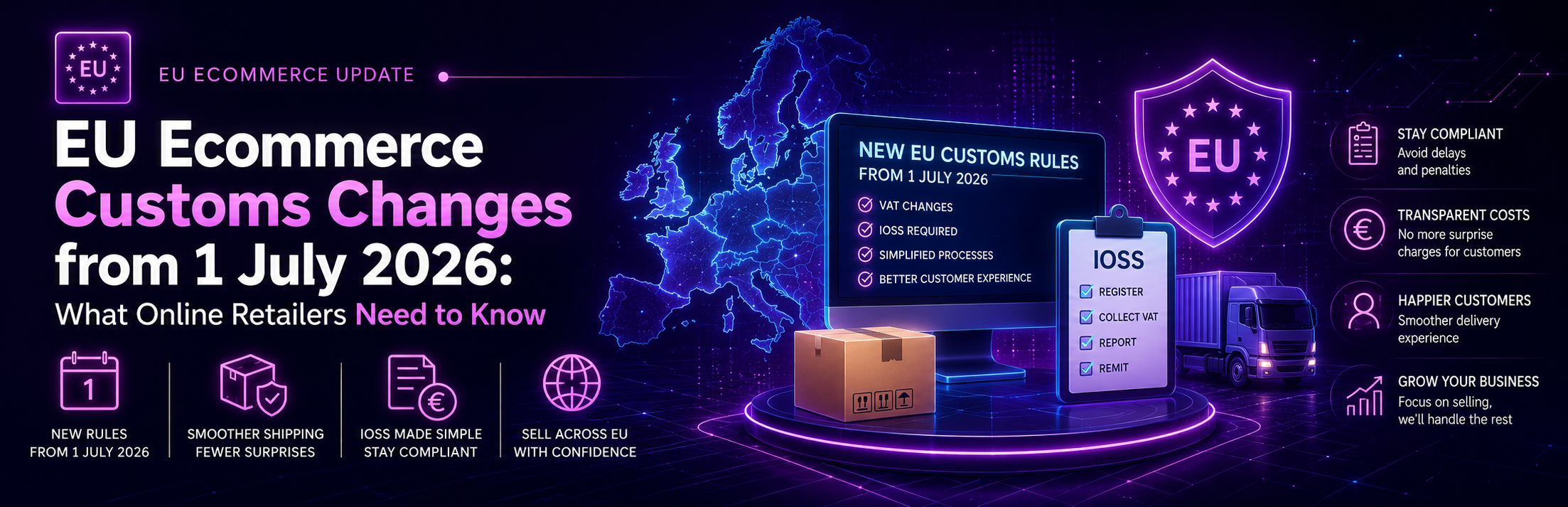
Businesses sending ecommerce orders from the UK or another non-EU country to customers in the European Union will face an important customs change from 1 July 2026.
Until now, goods sent directly to EU consumers in consignments worth no more than €150 have normally been exempt from customs duty. Import VAT has still been payable, but customs duty has generally not applied.
From 1 July 2026, that customs duty exemption is being replaced by a temporary €3 customs duty for low-value ecommerce imports.
This means businesses selling to EU customers may need to update their websites, product information, shipping integrations and checkout processes.
What is changing?
From 1 July 2026, ecommerce orders entering the EU from outside the EU and valued at up to €150 will generally be subject to a €3 customs duty.
However, the €3 charge is not always calculated once per parcel or once for every physical product.
It is charged for each different customs item category included in the customs declaration. These categories are normally determined using the product’s commodity or HS code, description and, where applicable, country of origin.
For example:
- Two identical T-shirts using the same commodity code may result in one €3 customs charge.
- A T-shirt and a ceramic mug will normally be two different customs categories, resulting in a €6 charge.
- Several products covering four different commodity-code categories could result in a €12 charge.
Accurate product classification will therefore become increasingly important.
The temporary €3 duty is expected to remain in place until July 2028, when the EU plans to move to its wider customs reform system and apply the normal customs tariff for each type of product.
Customs duty and VAT are not the same thing
Customs duty and VAT are not the same thing
One of the most important points for ecommerce businesses is that the new €3 customs duty is separate from EU import VAT.
EU VAT already applies to imported ecommerce goods. The VAT rate depends on the customer’s delivery country and, in some cases, the type of product being sold.
The new charge creates two separate amounts:
- EU VAT, normally calculated as a percentage of the sale.
The new €3 customs duty, calculated according to the different customs item categories in the consignment. - There may also be a carrier, postal operator or customs administration fee. These handling fees are separate from both VAT and the €3 customs duty.
The EU has discussed introducing an additional Union handling fee, but this is separate from the confirmed €3 customs duty and should not be treated as part of the July charge unless further rules are announced.
What is IOSS?
OSS stands for Import One Stop Shop.
It is an optional VAT scheme designed for direct-to-consumer orders imported into the EU in consignments worth no more than €150.
When IOSS is used, the ecommerce business collects the customer’s EU VAT during checkout. The VAT is then reported and paid through a monthly IOSS return.
This means the customer should not normally be asked to pay the same import VAT again when the parcel reaches the EU.
IOSS does not remove the new customs duty, nor does it convert the €3 charge into VAT. The customs duty must still be dealt with through the customs declaration, carrier or customs representative.
For a business established in Great Britain, using IOSS typically requires appointing an approved intermediary. The intermediary registers the business, submits monthly IOSS returns and pays the VAT to the relevant authority on the business’s behalf.
Businesses selling through marketplaces such as Amazon or eBay may find that the marketplace operates IOSS for qualifying orders. However, this should be confirmed with the marketplace because the seller may still be responsible for providing correct product and shipping information.
What needs to be integrated into an ecommerce website?
A basic IOSS or EU customs integration may require more than simply adding a €3 fee at checkout.
The website and order-management system may need to identify:
- Whether the delivery address is inside the EU.
- Whether the customer is a consumer or a VAT-registered business.
- Whether the consignment value is no more than €150.
- The correct EU VAT rate for the delivery country.
- The commodity or HS code for each product.
- The country of origin of each product.
- How many different customs item categories are in the order.
- Whether the goods are excluded from IOSS, such as certain excise goods.
- Whether the order should use an IOSS, duties-paid or customer-pays-on-delivery process.
The correct information must then be passed to the courier, postal operator, fulfilment company or customs agent.
The IOSS number must also be transmitted securely as part of the customs declaration. It should not normally be printed publicly on invoices, order emails or parcel labels where it could be copied and misused.
Orders worth more than €150 must be separated from the IOSS process because they follow the normal import VAT and customs duty rules.
What costs should a business expect?
The cost will depend on the number of EU orders, the ecommerce platform, the products being sold and the chosen shipping company.
Possible costs include:
The €3 customs duty
This applies to each different customs item category declared in the qualifying consignment.
The retailer can include this within the product price, add it as a clearly displayed checkout charge, include it within the delivery price or absorb it within its margin.
IOSS intermediary fees
Great Britain-based businesses will normally need an intermediary to use IOSS.
Providers may charge:
- A registration or setup fee.
- A monthly administration fee.
- A charge for each transaction.
- A percentage of the VAT or order value.
- A minimum monthly fee.
- Additional charges for corrections, returns or late information
There is no single standard IOSS price, so providers should be compared carefully.
Website development
The website may require development to calculate destination VAT, identify orders below the €150 limit, group products by commodity code and display the correct charges.
Additional work may be needed to integrate the website with the chosen IOSS provider, accountant, shipping platform or courier.
Product data preparation
Every product being sent internationally should have an accurate description, commodity code, country of origin and value.
A business with a large catalogue may need to review and update hundreds or thousands of products.
Courier and customs fees
Couriers may charge customs clearance, disbursement, advancements, or administration fees.
These fees can sometimes be considerably higher than the €3 customs duty itself, particularly when the recipient is asked to pay after the parcel has arrived.
Can the customer pay the charges when the parcel arrives?
A retailer can choose not to collect EU VAT and customs charges at checkout and instead send orders on a customer-pays-import-charges basis.
In practical terms, the courier or postal operator will normally make the customs declaration, pay or guarantee the amounts required by customs and then ask the customer to pay before delivery.
The customer could be charged:
- Import VAT.
- The new €3 customs duty for each relevant item category.
- A courier or postal administration fee.
- A customs-clearance or disbursement fee.
This approach may require less checkout development, but it does not mean the retailer can ignore the new customs rules.
The retailer must still provide accurate customs information, including the product description, value, commodity code and country of origin. A statement in the website terms saying that the customer is responsible does not replace the customs declaration or automatically move every legal responsibility to the customer.
EU guidance also places the initial responsibility for declaring and paying the duty on the customs declarant. This will often be the platform, seller, carrier or customs representative. Making the consumer the declarant is intended to be a limited option rather than the normal ecommerce process.
The exact arrangements should therefore be agreed with the business’s courier or postal operator.
What are the disadvantages of making the customer pay?
The customer-pays approach can appear cheaper for the retailer, but it creates several commercial risks.
Customers may not understand that VAT and duty are still outstanding. They may believe the checkout total is the final price and be surprised when the courier requests another payment.
This can lead to:
- Customers refusing delivery.
- Parcels being returned or abandoned.
- Complaints and payment disputes.
- Chargebacks.
- Negative reviews.
- Increased customer-service work.
- Delayed deliveries.
- Additional return and storage costs.
- Customers choosing an EU-based competitor next time.
A €3 customs duty can also result in a much larger payment request once import VAT and the courier’s administration fee are added.
If this option is used, the website should display a prominent message before payment explaining that the price does not include EU import VAT, customs duty or courier clearance charges.
The same warning should appear in the delivery information, terms and conditions, order confirmation and dispatch email.
Is collecting everything at checkout better?
For many established ecommerce businesses, presenting customers with a delivered price is likely to provide the best buying experience.
This can involve:
- Using IOSS to collect EU VAT.
- Calculating or recovering the €3 customs duty.
- Using a courier or customs service capable of delivering without additional customer charges.
- Clearly showing the total price before the customer completes the order.
The main benefit is certainty. The customer knows the complete cost and is less likely to refuse the parcel.
However, this option requires more accurate product data, integration work, ongoing reporting and coordination with the IOSS intermediary and shipping provider.
What about orders over €150?
IOSS cannot be used when the total intrinsic value of the consignment exceeds €150.
These orders must follow the normal customs process. Import VAT and normal product-specific customs tariffs may apply, together with the courier’s customs-clearance fees.
The website should therefore detect when an EU order exceeds the €150 limit and move it to a different delivery and customs process.
Businesses should also be careful about splitting one order into several parcels simply to keep each parcel below €150. Customs authorities can review transactions and may treat artificial arrangements as non-compliant.
What happens if no website changes are made?
Orders can still be sent to the EU, but doing nothing increases the risk of incorrect charges, customs delays and unhappy customers.
Possible problems include:
- The wrong VAT being charged.
- Missing or inaccurate commodity codes.
- The wrong number of €3 customs charges.
- The customer being charged VAT twice.
- The carrier rejecting incomplete customs data.
- Parcels being held while payment is requested.
- Customers refusing unexpected charges.
- Increased return and customer-service costs.
At a minimum, businesses should review their product data, speak to their courier and update the website’s delivery information before 1 July 2026.
Recommended steps for ecommerce businesses
Businesses currently selling to EU consumers should:
- Calculate how many EU orders are normally below €150.
- Decide whether to use IOSS or make customers responsible for import VAT.
- Ask couriers how they will collect and account for the new €3 duty.
- Add accurate commodity codes and countries of origin to products.
- Decide whether the customs duty will be absorbed, included in prices or shown separately.
- Update the checkout, delivery page and terms and conditions.
- Test orders containing several different product categories.
- Create a separate process for orders over €150.
- Review how returns and refunds will be handled.
- Allow enough time for development and testing before 1 July.
Conclusion
The change from 1 July 2026 does not prevent UK ecommerce businesses from selling to customers in the EU, but it does add another layer of cost and administration.
Using IOSS can make VAT easier for the customer, but the new €3 customs duty still needs to be handled separately. Businesses must also consider intermediary fees, website development, product commodity codes and courier charges.
Allowing customers to pay at import remains possible in many shipping arrangements, but it is likely to result in a less predictable customer experience. It should only be used after confirming the process with the carrier and clearly warning customers before they place their orders.
For many retailers, the best long-term approach will be to calculate the correct charges in advance and give EU customers a clear total price at checkout.
Disclaimer
This article provides general information and should not be treated as legal, tax or customs advice. Businesses should confirm their specific arrangements with their accountant, IOSS intermediary and shipping provider.
