
When customers visit an ecommerce website, one of the first things they want to know is whether the product they are looking for is available to buy and how quickly they can receive it.
It sounds simple, but stock availability can have a significant impact on customer confidence, purchasing decisions and ultimately the number of sales your website generates.
There is nothing more frustrating for a customer than finding the product they want, adding it to their basket and proceeding through checkout, only to discover that the item is unavailable or will take several weeks to arrive.
Providing clear, accurate and up-to-date stock information is an important part of delivering a good online shopping experience. However, many ecommerce businesses overlook just how much difference this information can make.
Displaying Live Stock Levels
One of the most effective ways to improve customer confidence is to provide accurate stock availability directly on your product pages.
Customers want reassurance that the product they are ordering is actually available and that their order can be fulfilled within the expected timeframe.
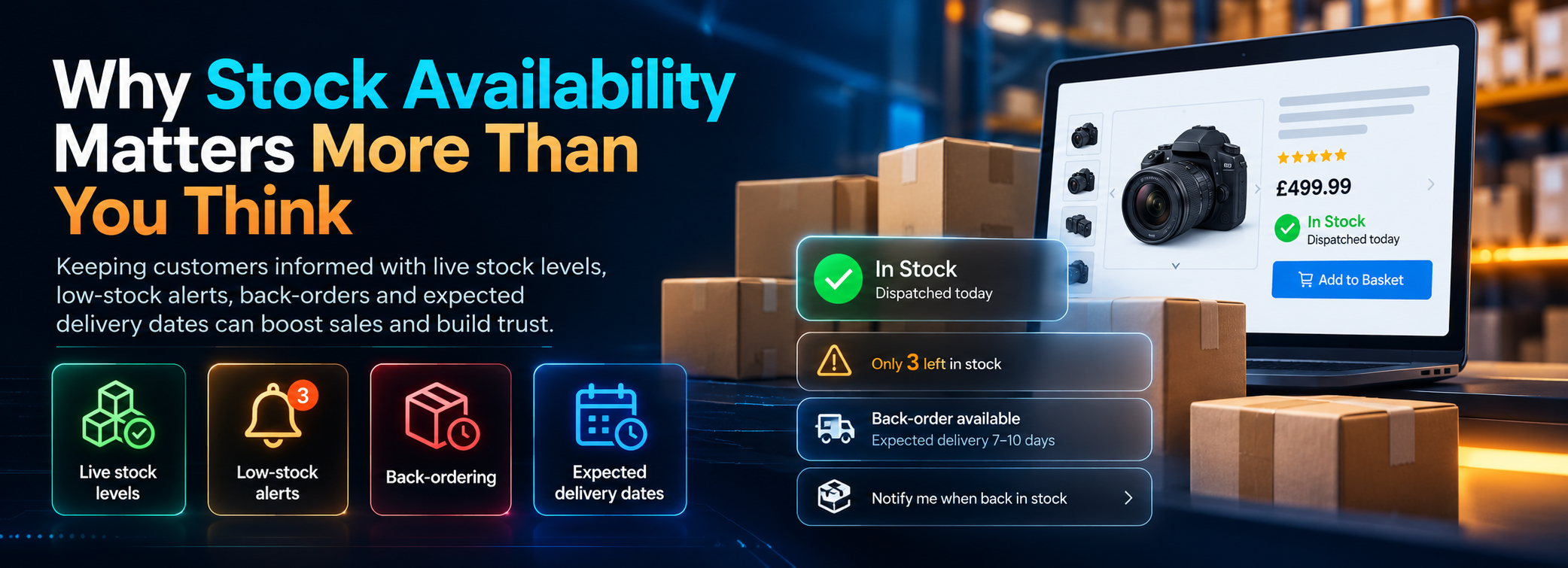
Displaying messages such as ‘In Stock’, ‘Available for Immediate Dispatch’ or even showing the number of items available can help customers make purchasing decisions with greater confidence.
For businesses selling through multiple channels, such as an ecommerce website, physical shop, marketplaces or trade sales, keeping stock levels synchronised is particularly important.
Integrating your ecommerce platform with your stock management, warehouse or accounting system can help ensure that availability is updated automatically as products are sold or new stock arrives.
This reduces the risk of overselling, disappointing customers and spending valuable time resolving orders that cannot be fulfilled.
Using Low-Stock Messages to Encourage Purchases
Low-stock messages can be an effective way of encouraging customers to complete their purchase rather than leaving the website and returning at a later date.
For example, displaying ‘Only 3 Left in Stock’ or ‘Limited Stock Available’ provides useful information while also creating a genuine sense of urgency.
Customers who may have been considering delaying their purchase are more likely to make a decision when they know that the product may soon become unavailable.
However, it is important that these messages reflect genuine stock availability. Displaying misleading stock warnings may encourage an initial purchase, but it can also damage customer trust.
Low-stock messaging works particularly well for popular products, seasonal items and products where stock is difficult to replenish quickly.
Don't Lose Sales Just Because a Product Is Out of Stock
Just because a product is temporarily unavailable does not mean the opportunity to make a sale has disappeared.
Many ecommerce websites simply display an ‘Out of Stock’ message and remove the ability to purchase the product. Unfortunately, this often leaves customers with little choice other than to look elsewhere.
Depending on the products you sell and your supply arrangements, offering a back-ordering facility can provide an alternative.
Back-ordering allows customers to purchase products that are currently unavailable, with the understanding that their order will be dispatched when new stock arrives.
This can be particularly useful for specialist products, spare parts, trade supplies and items that customers may find difficult to source from other suppliers.
The important thing is to make it clear that the product is on back order and provide a realistic indication of when it is expected to become available.
Customers are often prepared to wait for the right product, providing they understand how long that wait is likely to be
Expected Delivery Dates Can Make the Difference
One of the biggest frustrations for online shoppers is uncertainty around delivery.
A product page that simply states ‘Available to Order’ does not really tell the customer very much.
Does this mean the product will arrive tomorrow, next week or in six weeks?
Providing an expected dispatch or delivery date gives customers the information they need to make an informed decision.
For example:
- In Stock – Dispatch Within 24 Hours
- Available to Order – Expected Dispatch in 3–5 Working Days
- On Back Order – New Stock Expected 15th November
- Made to Order – Estimated Delivery 2–3 Weeks
Where possible, this information can be automatically generated using stock availability, supplier lead times and delivery arrangements.
It is also important to distinguish between dispatch dates and delivery dates, as these are not necessarily the same.
Clear delivery information reduces uncertainty, helps manage expectations and can reduce the number of customer enquiries asking when an order will arrive.
Let Customers Know When Products Return to Stock
Not every customer will be prepared to place a back order, particularly if they are unsure when the product will become available.
However, that does not mean they are no longer interested in purchasing it.
Offering a ‘Notify Me When Back in Stock’ facility provides a simple way to retain potential customers who may otherwise leave your website and purchase from a competitor.
Customers can register their email address against a particular product and receive an automatic notification when new stock becomes available.
This functionality offers several benefits.
Firstly, it provides another opportunity to convert a visitor into a customer without relying on additional advertising.
Secondly, it helps businesses understand which unavailable products are generating the most interest.
If a particular product has a large number of customers waiting for stock, this information can be valuable when making purchasing and stock replenishment decisions.
Finally, automated notifications reduce the need for staff to manually contact customers when products become available.
For businesses with large product catalogues, this can save a considerable amount of administration time.
Use Stock Information to Recommend Alternative Products
Another opportunity that is often overlooked is recommending suitable alternatives when a product is unavailable.
Rather than simply displaying an out-of-stock message, ecommerce websites can suggest similar products, alternative manufacturers or compatible replacements that are currently available.
For example, a customer searching for a particular component may be happy to purchase an equivalent product from another manufacturer, providing it meets their requirements.
This is particularly relevant for businesses selling engineering products, spare parts, electrical components and other specialist goods.
By using product relationships, specifications and intelligent search functionality, an ecommerce website can help customers find alternatives rather than forcing them to start their search again.
This improves the customer experience while helping to retain sales that may otherwise have been lost.
Better Stock Information Can Reduce Customer Service Work
Accurate stock information does not just benefit customers; it can also improve the efficiency of your business.
When customers know whether a product is available, when it will be dispatched and what to expect if it is on back order, there is less need for them to contact your business for updates.
It also reduces the number of orders that require manual intervention because stock information was incorrect.
For businesses handling large numbers of orders, even a small reduction in stock-related enquiries and administration can make a noticeable difference.
Integrating your ecommerce website with your existing business systems can take this a step further, automatically updating stock availability, managing back orders and triggering customer notifications.
Making Stock Availability Work for Your Business
Every ecommerce business operates differently, and the way stock availability is displayed should reflect the products being sold and the expectations of its customers.
A retailer selling everyday consumer products may benefit from displaying live stock quantities and next-day delivery information.
A specialist engineering supplier may require more detailed lead times, back-ordering options and alternative product recommendations.
A business selling made-to-order products may need to display production times rather than traditional stock quantities.
The key is to provide customers with accurate, relevant information that helps them make a purchasing decision.
Conclusion
Stock availability is about much more than simply telling customers whether a product is in stock.
It is about building confidence, managing expectations, reducing abandoned purchases and making it easier for customers to buy from your business.
Live stock levels, low-stock warnings, back-ordering facilities, expected delivery dates and back-in-stock notifications can all contribute towards a better ecommerce experience.
More importantly, these features can help turn potential lost sales into completed orders while reducing unnecessary administration and customer service enquiries.
At Tristar Web Solutions, we have over 25 years of experience developing ecommerce websites and creating bespoke functionality for businesses with different operational requirements.
Whether you need to improve the way stock information is displayed, integrate your website with existing stock management systems or introduce back-ordering and automated customer notifications, we can help develop a solution that works for your business.
If you would like to discuss improving stock management and availability on your ecommerce website, please get in touch.